For more information about what data is available for request, click here.
Intimate Partner Violence is a term for any relationship violence or abuse that occurs when one intimate partner exerts power and control over their partner. It can include domestic violence, sexual assault and abuse, stalking, and teen dating violence.
Intimate Partner and Domestic Violence is a public health issue that impacts people all over Los Angeles County. Fortunately, there is help available.
24/7 LA County Domestic Violence Hotline: (800) 978-3600. Get support, shelter, and other services.
Los Angeles County Domestic Violence Council provides leadership in the creation and support of a victim/survivor-centered, coordinated countywide approach to addressing intimate partner violence.
If you have been physically hurt or are in immediate danger, call 9-1-1.
Domestic Violence Restraining Orders
There are many ways for intimate partner and domestic violence survivors to seek support. One way is with a Domestic Violence Restraining Order (DVRO). A DVRO is a protective tool that can be used by victims or survivors of domestic violence, intimate partner violence, family violence, and dating relationship violence.
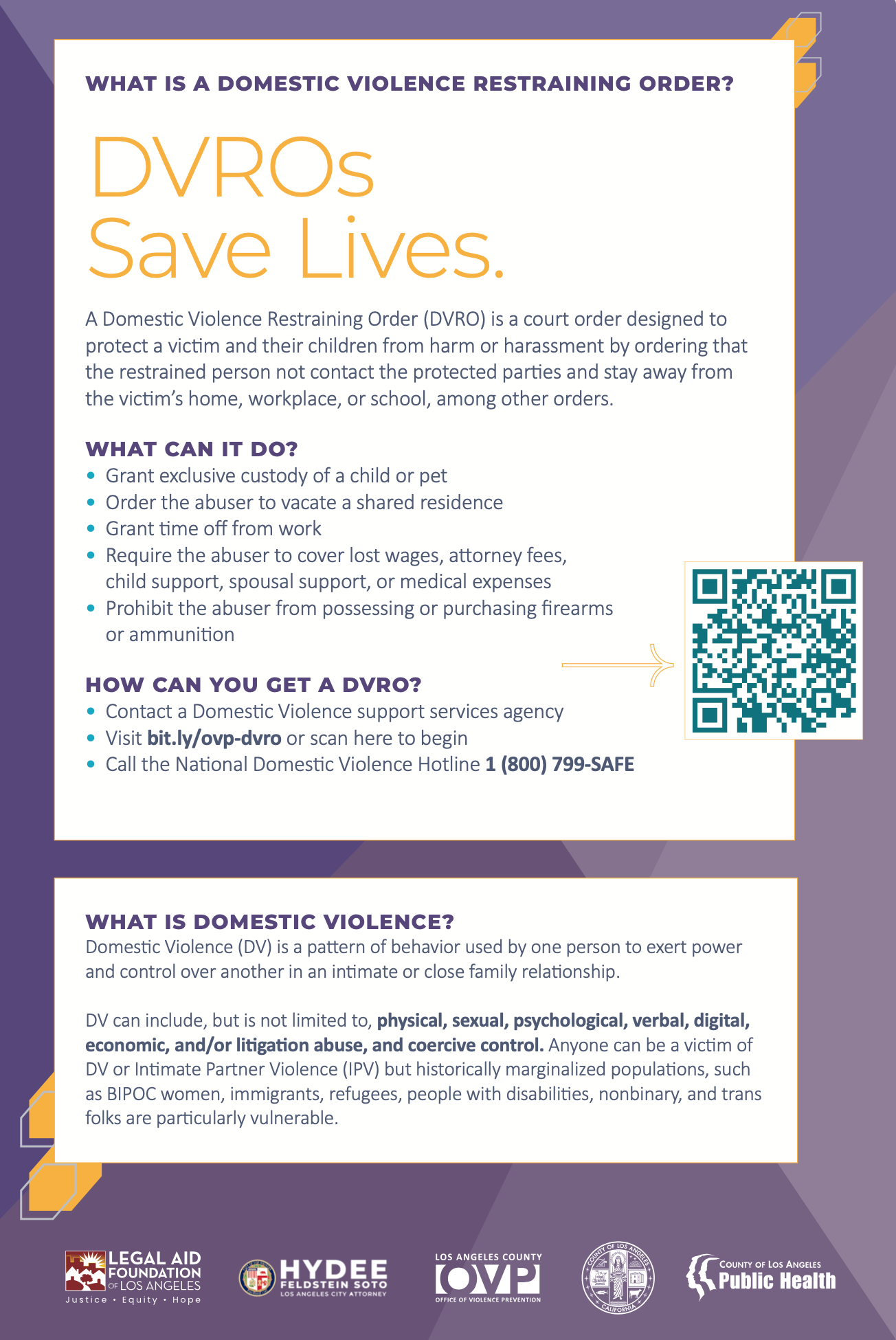
For more detailed information about Domestic Violence Restraining Orders, please download OVP's DVRO Rights Packet and DVRO Poster:
A DVRO is a court order designed to protect a victim and their children from harm or harassment by ordering that the restrained person not contact the protected parties and stay away from the victim’s home, workplace, or school, among other orders.
Who can get a DVRO?
Married or Former Spouse
Past or Present Dating Relationship
Family Members to “the second degree” (by blood, marriage or adoption): grandparents, parents, children, grandchildren and siblings
Registered Domestic Partner or Former Registered Domestic Partner
Cohabitant or Former Cohabitant (Not Merely a Roommate)
Parties With Children in Common
What can a DVRO do?
A DVRO can include protections such as:
No contact
Not harass, stalk, threaten or harm people protected by the order
Stay away by a certain distance
Move out from a home that is shared with the protected person
Not have guns, firearms, ammunition, or body armor
Pay spousal support, if you are married
Pay child support, if you have children together
Pet custody
Attend batterer’s treatment program
Cover attorney fees
What are the steps to getting a DVRO?
Step 1: Determine the correct courthouse for you
Step 2: Get the “Request for Domestic Violence Restraining Order” application and complete the forms
Step 3: Submit the completed forms
Step 4: Judge reviews your documents
Step 5: Pick up completed forms, mark your calendar with the hearing date
Step 6: Attend hearing
Step 7: File the DVRO
Step 8: Distribute copies of DVRO
How to collect evidence for a DVRO
If it is safe to do so, you can gather evidence before you file, but you can also begin to collect evidence after filing. Keep a record of each incident, take photos of injuries and property damage (note who took them and what time), and store all evidence in a secure location.
For more information on collecting evidence, visit WomensLaw.org.
Who can help me get a DVRO?
There are people who want to help and support you! Below are some organizations that can help.
Los Angeles County Bar Association: In-person services offered by appointment only at Central Division-Family Justice Center. Call 213-624-3665 or email: dvp@lacba.org
Coalition to Abolish Slavery & Trafficking: 888-539-2373
What to expect when you reach out to a hotline
Answer some basic questions about who you are and what you are going through
Get connected to a trained counselor who will listen to you without judgement
All of your messages are anonymous, and you can share as much or as little as you like
Receive individual support. You can hang up or end the chat at any point.
If there is a wait, try a calming exercise to help you breathe and focus.
Be proud of yourself! Asking for help is courageous and powerful.
Domestic Violence Restraining Orders System Mapping Project
In the spring of 2024, OVP, in collaboration with the Domestic Violence Council (DVC), brought together a diverse group of partners including survivors, domestic violence providers, community leaders, law enforcement, City and County departments, court representatives, and other service providers to participate in a system mapping workgroup.
The workgroup engaged in a 5-month system mapping process to identify cross-sector opportunities to overcome barriers and enhance survivors' access to Domestic Violence Restraining Orders (DVROs) in Los Angeles County. Using a System Mapping methodology, the workgroup analyzed obstacles within policies, practices, and processes that hinder DVRO access.
Through this visual mapping, the workgroup was able to identify and illustrate the barriers to the current DVRO process. The map depicting the current state of the DVRO process can be downloaded here.
The workgroup then identified 13 strategies to improve access to and increase safety and support for survivors seeking a DVRO. In the future state map, a more accessible and supportive system is imagined. The future map can be downloaded here:
Our hope is that these maps will help County, City, and community partners in advocating for the necessary changes to the DVRO process.
2025 Achievement Award
In 2025, the DVRO System Mapping Project won an Achievement Award for Promising Practice from the National Association of County and City Health Officials (NACCHO).
Contributors
OVP would like to thank the following organizations for their contribution to this project:
American Indian Counseling Center
California Association of Anger Management Providers
California Commission on Disability Access
East Los Angeles Women’s Center
Jenesse Center, Inc.
Homeboy Industries
Legal Aid Foundation of Los Angeles
Long Beach Department of Health and Human Services
Los Angeles Department of Public Health
Los Angeles Center for Law and Justice
Los Angeles City Attorney's Office
Los Angeles County Counsel
Los Angeles County Probation Department
Los Angeles County Women and Girls Initiative
Los Angeles Department of Mental Health
Los Angeles District Attorney’s Office
Los Angeles Homeless Services Authority
Los Angeles Police Department
Los Angeles Sheriffs’ Department
Los Angeles Superior Courts
Los Angeles Superior Courts - Self Help
Metropolitan Church of Christ - Carson
New Directions Counseling Center La Mirada
North Valley Anger Management Consultants
Rainbow Services
Strength United
The People’s Concern
Volunteers of America, Los Angeles
Young B.O.S.S. NPO
YWCA San Gabriel Valley
Reports
2010 Los Angeles County Domestic Violence Data Sources