
Bats
primary endemic rabies reservoir in LA County; all bat and wildlife contact requires evaluation
Rabies rising
2026 has surpassed 2025, the previous record, for rabid bats in LA County
Report all bites
all mammal bites to humans must be reported to Veterinary Public Health
Rabid raccoon
first rabid raccoon detected in LA County since 1973; read more
This page is for veterinary providers and animal control staff. Looking for something else?
All mammal bites to humans must be reported to Public Health. Rodent, squirrel, and rabbit bites are not reportable.
- Online: Bite Reporting Portal
- Fax or email:
Bite Report / Suspected Rabid Animal Form (AC/Vet)
- Fax: (213) 481-2375
- Email: vet@ph.lacounty.gov
For consultation on a suspected rabid animal, bite management, or quarantine questions, contact a VPH veterinarian:
- Weekdays 8:00 AM to 5:00 PM: (213) 288-7060
- Email: vet@ph.lacounty.gov
See the Suspected Rabid Animal tab below for the full protocol.
- Long Beach Animal Care Services — (562) 570-7387
- Pasadena Humane Society — (626) 792-7151
- Southeast Area Animal Control Authority (Vernon) — (562) 803-3301
Protocols & Requirements
VPH Manual (2022)
Clinical Signs of Rabies in Animals
Rabies affects the central nervous system and follows a progressive course. Early signs are often nonspecific and easily attributed to other conditions. Any animal with unexplained neurologic signs, particularly with a known or suspected wildlife exposure history, should prompt consideration of rabies.
Protocol: Suspected Rabid Animal
Step 1 Isolate the animal immediately
Separate the animal from all people and other animals to prevent further exposure.
Step 2 Contact Veterinary Public Health
Call (213) 288-7060 (Monday to Friday, 8:00 AM to 5:00 PM) or email vet@ph.lacounty.gov.
Step 3 Submit a report
Use the form that matches the situation:
- Bite Report / Suspected Rabid Animal Form (AC/Vet) - for veterinarians and animal control to report domestic animals or wildlife that have bitten a person or are suspected of having rabies (if no person was bitten, leave the Person Bitten section blank or write N/A)
- Domestic vs. Wild Mammal Incident Report Form - for domestic animals bitten by wildlife
- Bat Submission Form for Rabies Testing - for any bat requiring testing
Email to vet@ph.lacounty.gov or fax to (213) 481-2375. If no person was bitten, leave the Person Bitten section blank or write N/A.
Step 4 Prepare the specimen and arrange pickup
Follow the step-by-step specimen preparation instructions. Note on the form that pickup is needed, then call (213) 288-7060 to confirm. Specimens must be refrigerated, not frozen, and picked up promptly; unrefrigerated or decomposed specimens may be untestable.
For additional guidance on bite reporting and rabies control, see the 2022 VPH Manual.
Vaccination Requirements
Requirements
California state law requires rabies vaccination for dogs. A Los Angeles County ordinance requires rabies vaccination and licensing of cats, and many cities in LA County uphold this requirement. Requirements are based on where the owner lives, not where the clinic is located. See the 2022 VPH Manual for a city-by-city breakdown. Regardless of legal requirements, rabies vaccination is strongly recommended for all cats, including indoor-only cats: rabid bats are found inside homes every year.
Veterinarians are required to submit rabies vaccination certificates to the local Animal Control agency for cities that mandate it. See the 2022 VPH Manual for a list of which cities require submission and the designated provider for each. For applicable laws, see California Rabies Laws.
Vaccination Exemptions
In LA County, VPH has authority to grant rabies vaccination exemptions for dogs when vaccination would endanger the animal's life. For full exemption criteria, see the 2022 VPH Manual. Key points for veterinarians:
- Exemption requests must be submitted by the veterinarian, not the dog owner.
- Exemption forms are not available online. Contact VPH to request them: (213) 288-7060 or vet@ph.lacounty.gov.
- A complete submission requires both forms, the owner's and veterinarian's signatures, and up to 5 pages of supporting medical records. Incomplete submissions are automatically denied.
- Exemptions are valid for one year only and must be renewed annually. Permanent exemptions do not exist.
- Approved dogs are considered legally unvaccinated and subject to a 180-day quarantine if exposed to wildlife.
Quarantine Requirements
Any domestic animal involved in a bite incident or wildlife exposure must be quarantined. Quarantine applies regardless of vaccination status. See the flowcharts below for length by scenario.
Animals That Have Bitten a Person
- All domestic animals that bite a person are placed under quarantine and observed for clinical signs of rabies by VPH staff. The animal remains under quarantine until VPH issues a Quarantine Release Notice.
- Do not administer a rabies vaccine or booster during the quarantine period for animals that have bitten a person.
- Domestic animals not subject to quarantine: rabbits, rodents, birds, and reptiles.
- Captive exotic mammals (such as zoo animals) that have bitten a human are quarantined at their facility for a minimum of 30 days.
- Do not euthanize a quarantined biting animal without prior VPH authorization — the brain must be preserved intact for rabies testing. Exception: humane euthanasia is permitted without prior approval for grave illness or injury. In such cases, the head must be submitted for rabies testing.
Animals Exposed to Wildlife
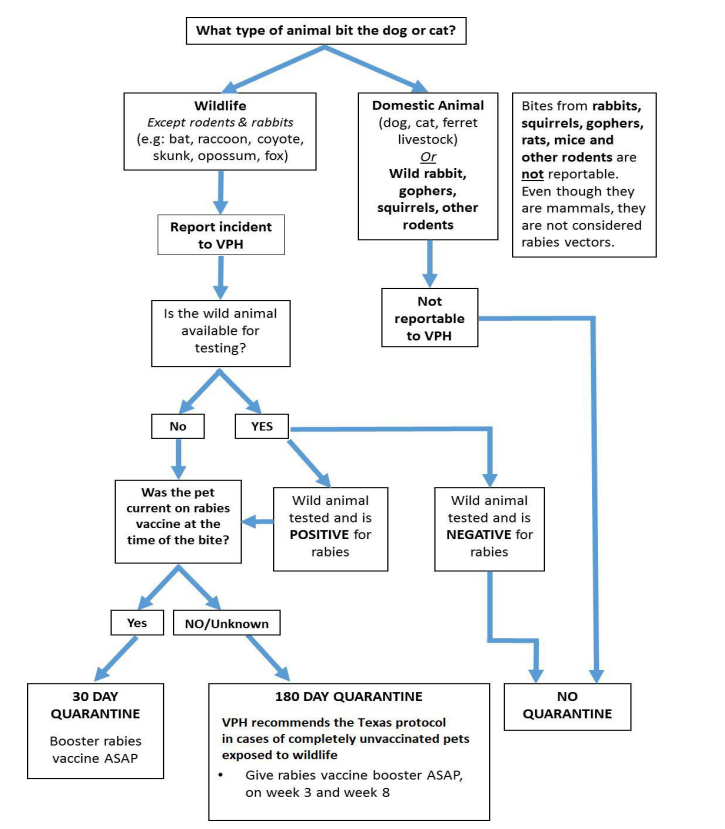
- Whenever possible, the wild animal should be humanely euthanized and submitted for testing. A negative result eliminates the need for quarantine of the domestic animal.
- If the wild animal is not tested or tests positive, quarantine the domestic animal based on vaccination status (see flowchart).
- Vaccination/booster recommendations following wildlife
exposure:
- Current on rabies vaccine: administer a booster immediately, even if not yet due.
- Not current on vaccine: vaccinate immediately post-bite (or when medically stable).
- Never vaccinated: follow the Texas protocol: vaccinate immediately, again at week 3, and again at week 8.
- Location transfers of quarantined animals are not permitted without prior VPH approval. Moving a quarantined animal to a shelter or veterinary clinic for care is always allowable.
- Do not euthanize a quarantined animal without prior VPH authorization — the brain must be preserved intact for rabies testing. Exception: humane euthanasia is permitted without prior approval for grave illness or injury. If euthanized, the head must be submitted for rabies testing.
Animal Bitten by Animal
Animal Bites a Human

Animal Bitten by Animal: Quarantine Decisions
Animal Bites a Human: Quarantine Decisions
For full quarantine protocols, see the 2022 VPH Manual or the Rabies Quarantine & Booster Guidance (Sept 2026).
Bat Encounters


Situations Requiring Reporting and Testing
- Any bat found dead, sick, or injured in a public area, yard, home, or business
- Any bat that may have bitten or scratched a person or animal
- Any bat found indoors where a person could not confirm no exposure (e.g., sleeping or unconscious person or child) or if a pet was present
When a Client Brings In or Reports a Bat
Collect the client's name and contact information; VPH will need to speak with them directly. Then advise:
- Do not touch the bat with bare hands or release it.
- If possible, cover it with a bucket or box to contain it.
- Call local animal control for collection and submission for testing.
Submitting a Bat for Testing
Bats must not be decapitated. Submit the whole body. Complete the Bat Submission Form for Rabies Testing, affix it to the container, and call (213) 288-7060 to arrange pickup. See the specimen preparation instructions for full packaging and refrigeration requirements.
See also: Bat in the Home: Clinical Decision Flowchart | What to Do If You Find a Bat (PDF)
Specimen Submission for Rabies Testing
What to Submit
- Bats: submit the whole body — do not decapitate. Use the Bat Submission Form for Rabies Testing.
- Dogs, cats, and other domestic animals: if euthanized, submit the head only. Use the Bite Report / Suspected Rabid Animal Form (AC/Vet).
- Wildlife (non-bat): submit the whole carcass or head, depending on size. Contact VPH for guidance.
How to Submit
- Complete the appropriate submission form and affix it to the container.
- Follow all specimen preparation instructions for packaging and refrigeration.
- Call (213) 288-7060 (Monday to Friday, 8:00 AM to 5:00 PM) to arrange pickup. Note on the form that pickup is needed.
- Keep the specimen refrigerated until pickup. Do not freeze.
Required Forms
- Bat Submission Form for Rabies Testing — for bats
- Bite Report / Suspected Rabid Animal Form (AC/Vet) — for domestic animals and wildlife
LA County Resources

VPH Rabies Control & Animal Disease Reporting Manual (2022)

Bite Report / Suspected Rabid Animal Form (AC/Vet)

Rabies Specimen Preparation Instructions

Animal Bites & Rabies Risk: LA County

California Rabies Laws

Bat in the Home: Clinical Decision Flowchart

Rabies Training for Animal Shelter Staff

Online Animal Bite Reporting Portal

Rabies in Animals in LA County (Case History)

What to Do If You Find a Bat
News & Updates
- First Rabid Raccoon Detected in LA County Since 1973 (10-5-26)
- LA County Marks World Rabies Day Amid Record Year for Bat Detections (9-28-26)
- Public Health Reports Second-Highest Number of Rabid Bats Ever Recorded in LA County (11-5-25)
- Rabid Bats More Common During Summer and Fall (7-25-23)
- Potential Rabies Exposure at Malibu Cafe/Calamigos Ranch (6-10-22)